

What Are Embedded & Autonomous AI Agents?
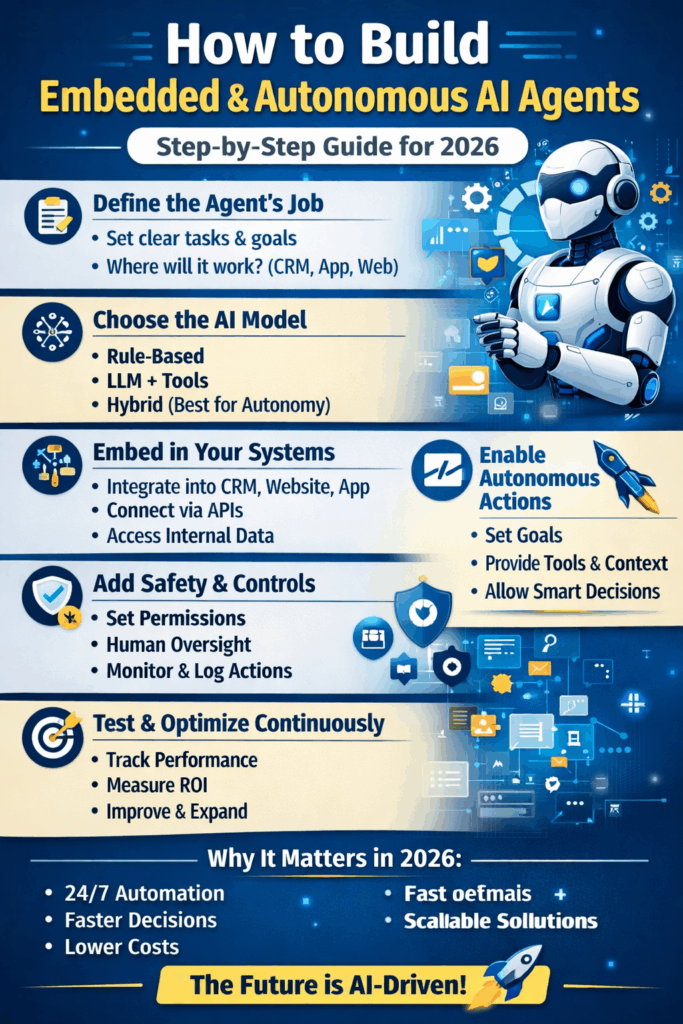
Embedded AI Agents are AI systems integrated directly into software, apps, or business workflows.
Autonomous AI Agents can plan, decide, and take actions on their own with minimal human input.
👉 Example:
A support agent that replies to customers, creates tickets, and escalates issues automatically
A sales agent that qualifies leads, sends follow-ups, and updates CRM
An operations agent that monitors data and triggers actions
Step 1: Define the Agent’s Job Clearly
Before building anything, answer this:
🔹 What exact task will the AI agent perform?
🔹 Where will it work? (Website, CRM, ERP, App, WhatsApp, etc.)
🔹 What decisions can it make on its own?
Good tasks for AI agents:
Customer support replies
Lead qualification
Report generation
Workflow automation
Data analysis & alerts
📌 Tip: Start with one focused task, not everything.
Step 2: Choose the Right AI Model
Select an AI model based on complexity:
Rule-based AI → Simple automation
LLMs (Large Language Models) → Reasoning, conversation, planning
Hybrid (LLM + tools) → Best for autonomous agents
Popular model use cases in 2026:
Text understanding & decision-making
Multimodal input (text + image + voice)
Tool calling (APIs, databases, apps)
Step 3: Embed the Agent into Your System
This is where “Embedded AI” happens.
You can integrate AI agents into:
Websites & web apps
CRM systems (sales & support)
Mobile apps
Internal dashboards
Email, WhatsApp, Slack, Teams
🔧 How embedding works:
AI connects via APIs
Accesses internal data securely
Operates inside existing workflows
📌 Result: AI becomes part of daily operations, not a separate tool.
Step 4: Enable Autonomous Decision-Making
To make an AI agent autonomous, give it:
✅ Goals – What outcome it should achieve
✅ Context – Data, history, rules
✅ Tools – APIs, databases, actions
✅ Memory – Short-term & long-term context
✅ Feedback loop – Learn from outcomes
Example:
If a lead matches criteria → qualify → send email → update CRM → notify sales
This is called Agentic AI behavior.
Step 5: Add Safety & Control Layers
Autonomous does NOT mean uncontrolled.
Always include:
Permission limits
Human approval for critical actions
Logging & monitoring
Error handling
Ethical & compliance checks
📌 Businesses trust AI agents only when they are safe, auditable, and predictable.
Step 6: Test, Measure & Optimize
Track performance like any employee:
📊 Metrics to measure:
Accuracy
Time saved
Cost reduction
Conversion improvement
Customer satisfaction
Continuously:
Improve prompts
Add better tools
Refine decision rules
Expand responsibilities gradually
Industries Using Embedded & Autonomous AI Agents
These industries are adopting fastest in 2026:
IT & SaaS – DevOps, support, automation
Finance & Banking – Risk analysis, fraud detection
Healthcare – Scheduling, diagnostics support
E-commerce & Retail – Personalization, inventory
Manufacturing – Predictive maintenance
Marketing & Sales – Lead nurturing, campaign optimization
Why Embedded AI Agents Matter in 2026
✔ Reduce operational cost
✔ Increase speed & efficiency
✔ Work 24/7
✔ Scale without hiring
✔ Deliver measurable business value
📌 As Barron’s and other analysts highlight:
Businesses are no longer experimenting with AI — they are deploying autonomous systems at scale.
ITS MyServices – Your AI-Driven IT Partner
📱 Call/WhatsApp: +91 9266803775
🌐 Website: www.itsmyservices.com
📧 Email: itsmyservicess@gmail.com
🌟 Facebook: itsmyservices
🌟 Instagram: itsmyservices
🌟 LinkedIn: itsmyservices
🌟 YouTube: @itsmyservices
🌟 YouTube: @itsmyservices